Code: 11581
Dimensions:
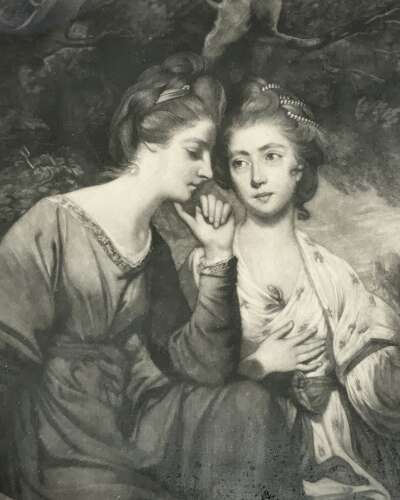
"Et In Arcadia Ego" (Mrs Bouverie & Mrs Crewe)
Mezzotint by Giuseppe 'Joseph' Marchi (1735-1808)
after Sir Joshua Reynolds, P.R.A. (1723-1792)
Published by Susanna Vivares
London 1785
Measures:-
46.5 cm x 53 cm (Sheet)
53.5 cm x 60 cm (Framed)
State as issued by Susan Vivares in 1785, without a title. Lettered below the image with the artists' details "Sr. Joshua Reynolds Pinxt. / Jos. Marchi Sculpt." and publication line "Publish'd According to Act July 24, 1785 by Susa. Vivares, No.13 Great Newport Street, London."
An good impression of this image with full margins. Well presented, framed and glazed in an antique Hogarth style frame with gilt-metal embellishments.
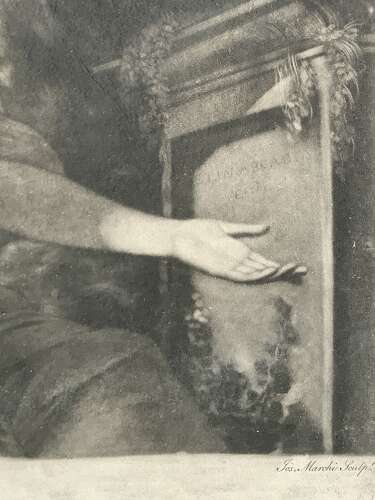
Double portrait of Mrs Bouverie and Mrs Crewe after Reynolds, three-quarter length, sitting, Mrs Crewe on the right, to the front, extends her left hand towards a cinerarium, lightly engraved with an inscription "ET. IN. ARCADIA. EGO." Mrs Bouverie, face in profile to left, leans her chin on her left hand as if in thought.
The work is an allegorical double portrait of the two inseparable friends, celebrated beauties and Whig hostesses, Henrietta 'Harriet' Fawkener (1750-1831) and Frances Anne Greville (1748-1818). Harriet was a daughter of Sir Everard Fawkener (1684–1758), British Ambassador at Constantinople. She first married the Hon. Edward Bouverie (later marrying the prominent Whig politician Lord Robert Spencer). Frances Anne was a daughter of Fulke Greville (1717–1806), British Envoy to the Elector of Bavaria. She married John Crewe, 1st Baron Crewe (their son John was the subject of another famous painting by Reynolds 'Master Crewe as Henry VIII' ). A famous Whig hostess, Sheridan was to dedicate his play 'The School for Scandal' to her.
The composition, the title and inscription lightly engraved on on the monument borrow from Poussin's Et in Arcadia ego which in turn borrows from Guercino's painting of the same title (also known as 'The Arcadian Shepherds')(Guercino's painting was the first recorded use of this now famous aphorism). The Latin "Et in Arcadia ego", here engraved on the plinth of the cinerarium, translates as "I am even in Arcadia". It serves as a memento mori to the viewer that death is ever present, even in idyllic surroundings and in the beauty of youth. The original painting was Reynolds' key exhibit in the Royal Academy’s inaugural exhibition of 1769 (No. 91 "Portraits of two ladies, half lengths. 'Et in Arcadio ego'").
Giuseppe (Joseph) Filippo Liberati Marchi (1735-1808) was born in Rome and brought to London as a studio assistant by Joshua Reynolds in 1752. Between 1766 and 1775 he primarily specialised in the engraving of Reynold's works in mezzotint.
This plate was first engraved by Marchi in 1770 and published by John Wesson. It appears that in due course the plate passed to the pioneering female printseller Susanna Parker Vivares (1734–1792) (wife of the engraver François (Francis) Vivares (1709-1780)) who reissued it in 1785.
For another impression of this state see British Museum 1902,1011.3431