Code: 11746
Dimensions:
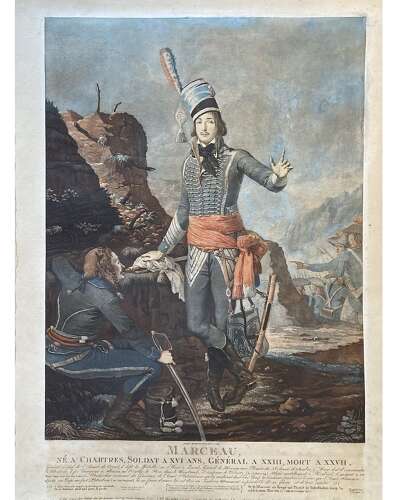
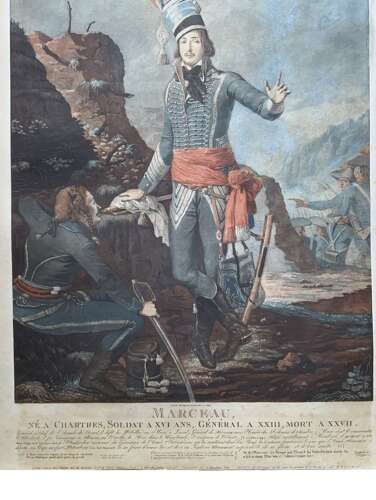
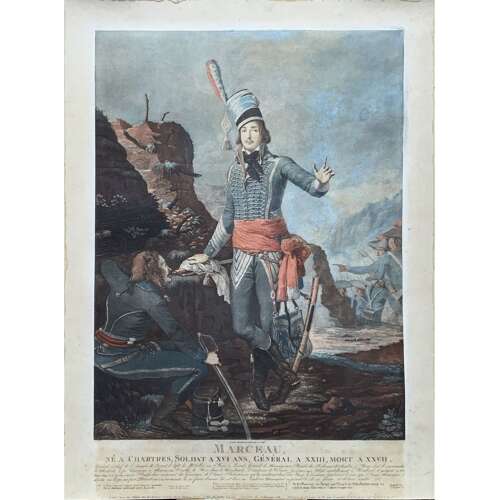
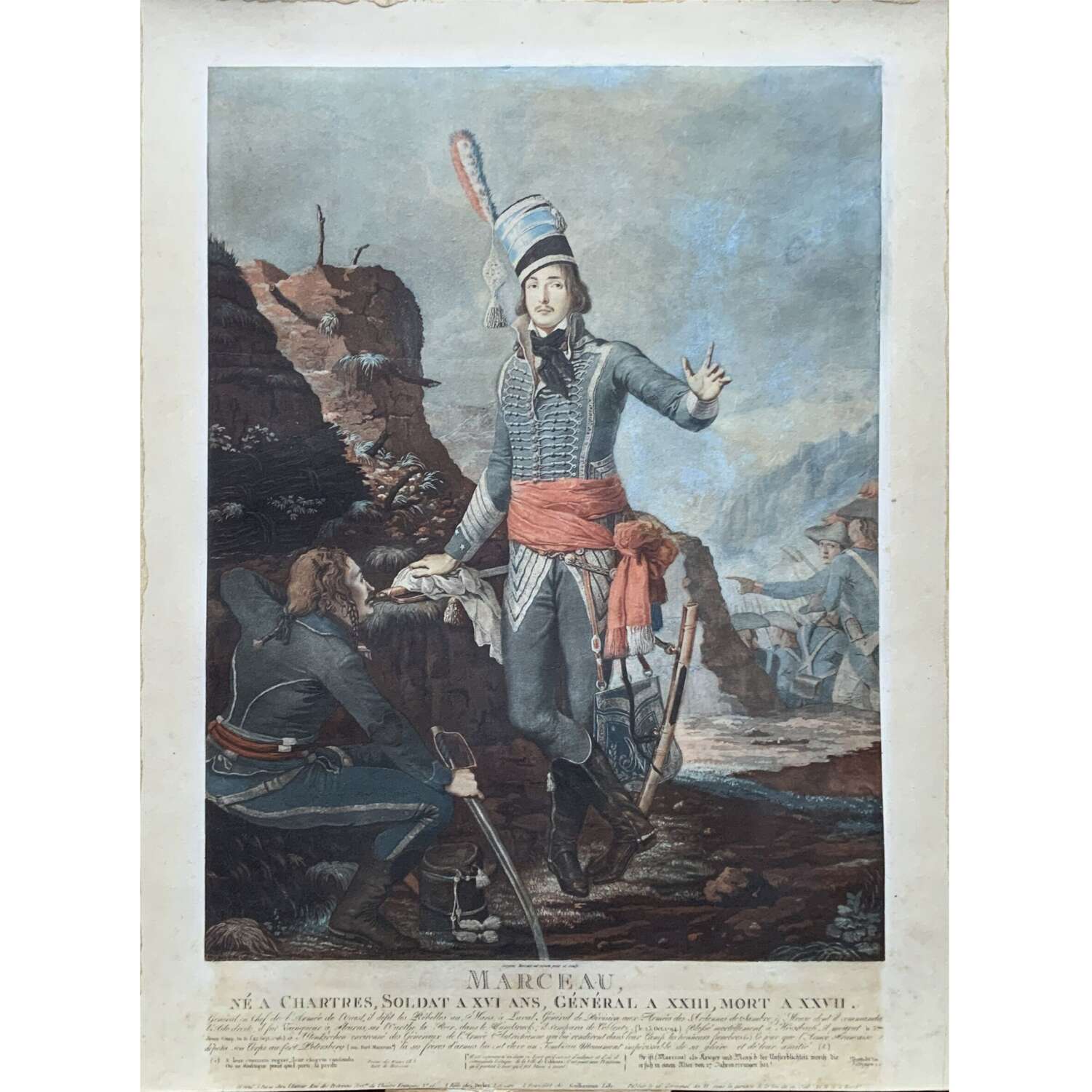
“MARCEAU”
(A portrait of the French Revolutionary General François Séverin Marceau-Desgraviers (1769-1796))
After Antoine François Sergent-Marceau (1751-1847)
Aquatint printed in colours
Engraved by Sergent-Marceau
Published by Sergent-Marceau, Johann Decker & Philipp Heinrich Guilhauman
Published in Basel, 1798
Measures:-
50.7 cm x 38 cm (sheet)
Provenance:-
Redfern Gallery, Cork Street, London, 1955
The artist and architect James Cubitt, FRIBA (1914-1983)
Lettered beneath with the artist’s details “Sergent Marceau ad vivum pinx et sculp” with the subject’s name “MARCEAU” and with extensive biographical inscription beginning “Né à Chartres, soldat à XVI ans, général à XVIII, mort à XXVII.” and with publication line to bottom margin 'A Paris chez l'Auteur, Rue des Poitevins Section du Théâtre Français No.16', 'A Bâle chez Decker Libraire' and 'A Francfort chez Guilhauman', and date of the publication: '26 Germinal An VI' [15 April 1798].
A highly sought after and technically ambitious engraving depicts the dashing and romantic young French Revolutionary General ‘Marceau’. Having joined the army at sixteen, despite bouts of ill-health and nearly falling foul of the guillotine for falling in love with and sheltering the daughter of an aristocratic royalist (who herself was executed), Marceau’s heroism led to his rapid promotion to the rank of general. He died aged twenty-seven, following wounds received during the Battle of Limburg in September 1796.
Marceau was buried with honour by his Austrian adversaries. A pyramid shaped monument, designed by his comrade General Jean-Baptiste Kléber (1753-1800), was erected over his grave and he was immortalised by Byron in verses in his epic poem “Childe Harold's Pilgrimage”:-
By Coblentz, on a rise of gentle ground,
There is a small and simple pyramid,
Crowning the summit of the verdant mound;
Beneath its base are heroes' ashes hid,
Our enemy's – but let not that forbid
Honour to Marceau! o'er whose early tomb
Tears, big tears, gush'd from the rough soldier's lid,
Lamenting and yet envying such a doom,
Falling for France, whose rights he battled to resume.
In 1889 his remains were transferred to the Panthéon.
The image, engraved in aquatint and printed in six colours in the manner of watercolour, was made by Marceau’s brother-in-law, the artist and revolutionary politician Antoine François Sergent-Marceau. (Secretary to the Jacobin Club, member of the National Convention and a vocal advocate for the execution of the king). Sergent-Marceau was married to General Marceau’s sister, Marie Louise (known as Émira), and added the deceased general’s name to his own after his heroic kinsman’s death. Sergent exhibited the portrait from which he made this engraving at the Salon of 1798. He campaigned to have the print distributed across France but, despite some official support, this never actually happened.
Scarce. See British Museum, 1902,0212.4; National Gallery of Art, Washington, D.C. (Gift of Mrs. W. Murray Crane), 1955.4.8; Harvard Art Museums/Fogg Museum (Acquisition Fund for Prints), 2016.12.; Musée Carnavalet, Histoire de Paris G.35270 etc