Code: 11342
Dimensions:
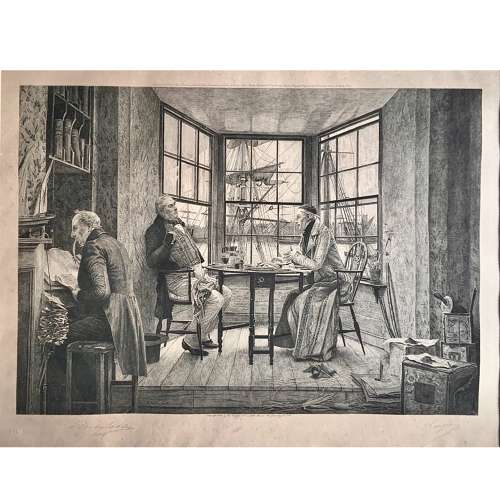
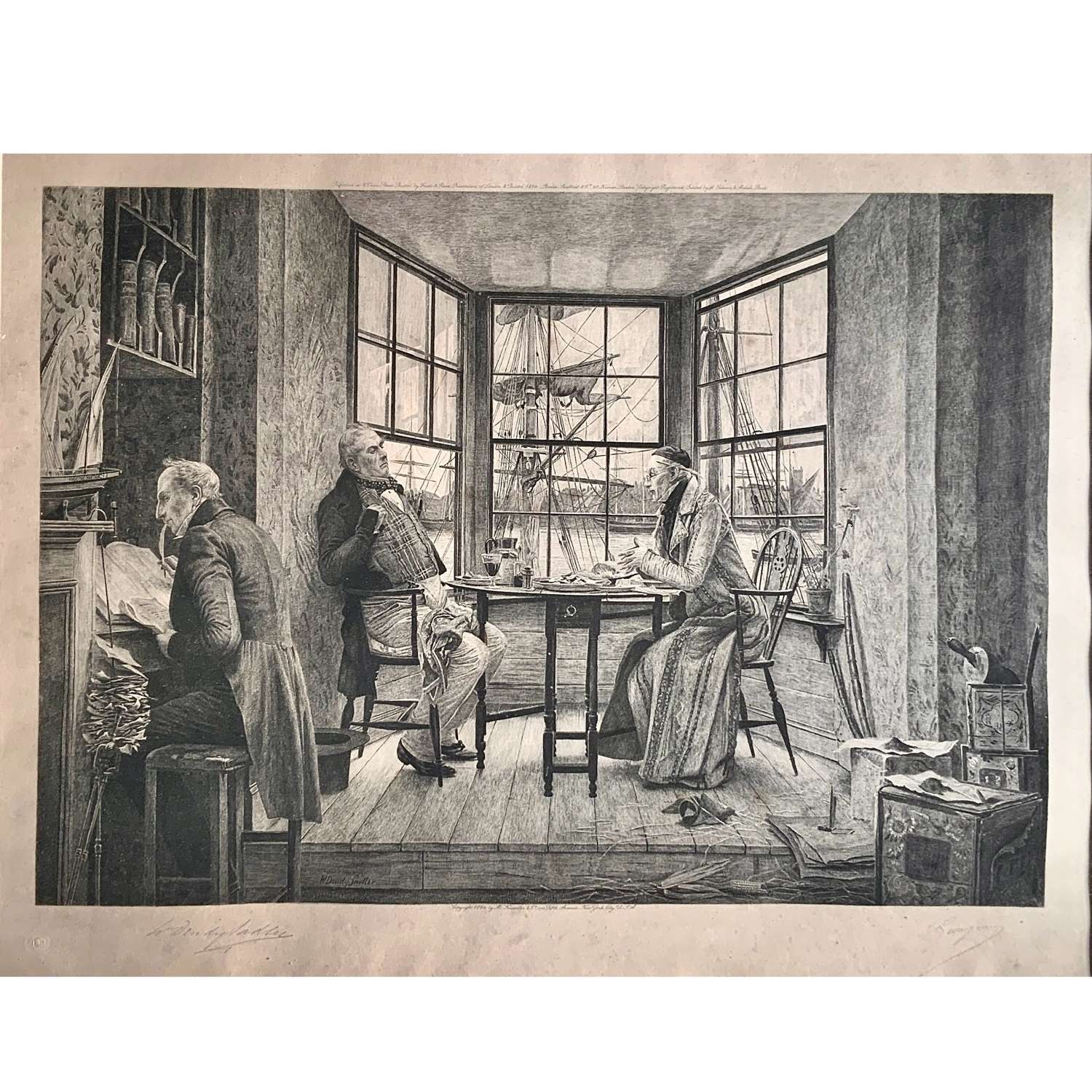
“The Middleman”
Walter Dendy Sadler R.B.A., R.I. (1854-1923)
Engraved by Eugène Gaujean (1850-1900)
Signed in pencil by both artist and printmaker.
Etching with engraving. Proof print on vellum paper.
Blindstamp of the "Printsellers' Association"
Published Frost & Reed London &
Knoedler & Co New York
1894
Measures:-
36.6 cm by 48 cm (Image)
61 cm by 73 cm (Framed)
Literature:-
p.117 , Vol XIV, "Pearson's Magazine", July to December 1902, C. Arthur Pearson Ltd, Henrietta Street, London, 1902.
Exhibited:-
Royal Academy 1892, No. 428 [Gallery VI] (the original painting).
Publication line top/bottom of the work: "Published at 8 Clare Street, Bristol by Frost & Reed, Printsellers of London & Bristol 1894 - Berlin, Steifbold & Co., 49, Kronen Strasse, Copyright Registered, Printed by A. Salmon & Ardail, Paris" / "Copyright 1894 by Knoedler & Co, 170 Fifth Avenue, New York City, U.S.A."
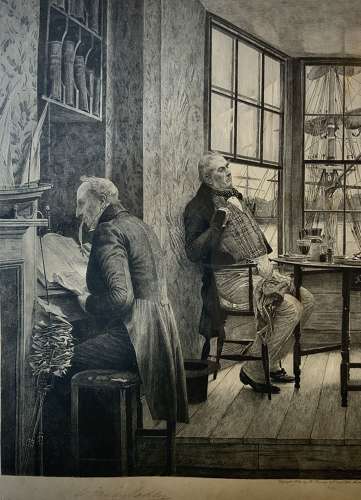
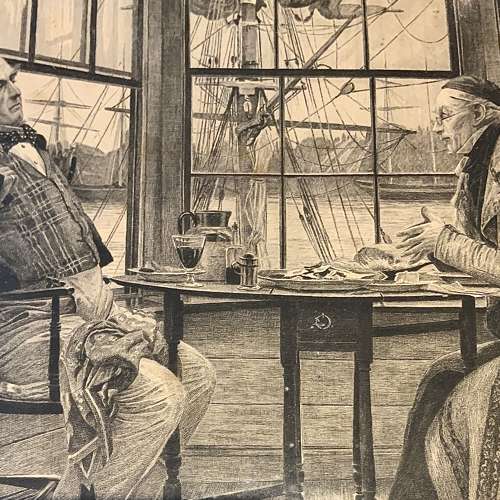
Walter Dendy Sadler was amongst the most successful and popular artists of his day, famed for his genre paintings which depict life in Regency and Dickensian England in the decades before his own birth. Sadler was keen to ensure that his works contained as much authentic detail as possible. In "The Middleman" the artist has imagined a lunch between two merchants of the 1830s. One of these gentleman appears to be a broker or trader who has travelled to exotic places the other, perhaps, a corpulent insurance underwriter. It is recorded that in order to find a suitable scene in which to set his picture:-
"he searched among old riverside houses until he found one-at Limehouse, with just such a room as he had fancied in his mind's eye whilst planning this picture of merchant's parlour at the time when merchants traded in their own homes with sea-captains from eastern ports."[1]
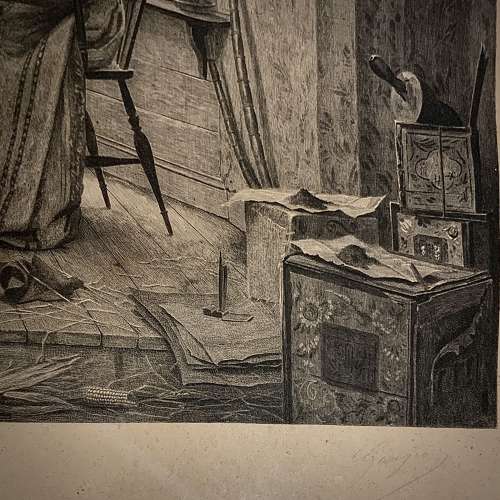
As with all such works, the viewer benefits immensely from making a closer examination of the detail. To the bottom right of the "merchant's" side of the picture can be found a pile of imported Chinese tea chests; the top one of which has been opened and has a scoop sticking into it. On the floor is an ear of maize or sweetcorn which was still an exotic plant (this wasn't widely cultivated in England until after WW2). Propped against the window still are two lengths of sugarcane - again an exotic and valuable commodity.
On the "underwriter's" side of the picture, a clerk is working at a leger, with numerous receipts on a paper-spike beside him. He seems to have become aware of another presence in the room (you the viewer) and is giving a 'side-eye' look. There is a model ship on the mantlepiece, reminding the viewer (as do the ships outside) that it is marine trade which is underpins this scene. The gentleman have enjoyed a classic Victorian meal of mutton and oysters, which sits on the table between them.
All this has been transcribed, through an extraordinary network of scratches and scrapes on a metal plate, into monochrome print by the master etcher and engraver Eugène Gaujean. He exhibited at the Salon in Paris between 1877 and 1894 and won a gold medal for his printmaking artistry at the Paris 'Exposition Universelle' of 1900. Gaujean worked for a number of artists (including Sir Edward Coley Burne-Jones and Sir Francis Dicksee) and publishers (including Agnews, Colnaghi and Knoedler & Co) transforming their works into published reproductions for the lucrative original print market.
Very scarce. Not in BM, Yale or other similar institutional collection.
Notes:-
[1] p.116 , Vol XIV, "Pearson's Magazine", July to December 1902, C. Arthur Pearson Ltd, Henrietta Street, London, 1902